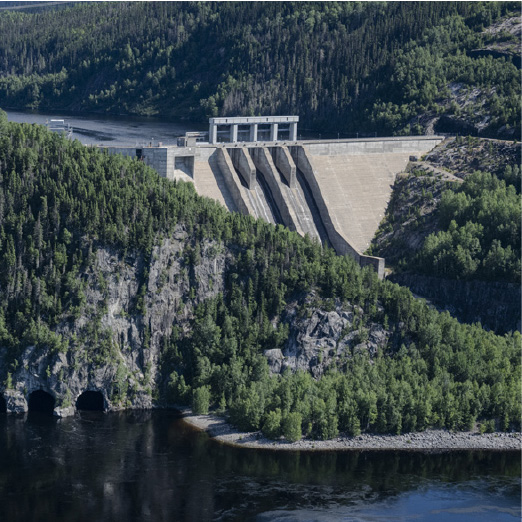
René-Lévesque Hydro Power Plant (Manic-3)
Hydro-Québec
Côte-Nord, Quebec
2020-2024
SIMCO (formerly COSIGMA) supported Hydro-Québec engineers during the preliminary project for rehabilitating the turbine-generator units (TGUs) at the René-Lévesque power station (Manic-3). SIMCO provided technical support for structural analyses.
The René-Lévesque power station (Manic-3), located on the Manicouagan River in Rivière-aux-Outardes on the Côte-Nord, was built between 1970 and 1975. It is equipped with six (6) turbine-generator units (TGUs) that generate a capacity of 1,176 MW. The station is unique in that it was built inside a large vaulted gallery integrated into the rock. As part of the preliminary project, an increase in hydroelectric production capacity was considered.
SIMCO carried out an assessment of the stress on several elements of the station: floors, columns, beams, and other structural components. To ensure precise and reliable results, specialized structural evaluation and design software was used to create three-dimensional analysis models of the station’s superstructure and infrastructure. For example, these models simulated the effects of moving loads from overhead cranes on the structure, which is crucial for evaluating the station’s stability and safety. The models assessed structural stresses related to the station’s current use as well as future operating scenarios. These scenarios included heavier production equipment, such as new TGUs, and specific loads during construction work.
Thanks to a thorough understanding of structural behavior, a balanced rehabilitation program was developed. SIMCO’s technical expertise optimized interventions by limiting the necessary reinforcements. SIMCO’s adaptability, experience in structural rehabilitation, and close collaboration with Hydro-Québec ensured efficient, durable solutions that met Hydro-Québec’s requirements and industry standards.
SIMCO’s mandate included the following tasks:
- Assessment of floor stress at the alternator floor level, including the assembly area and the area between units, based on loading scenarios;
- Assessment of stress on concrete columns induced by rotor assembly on the alternator floor;
- Study of the construction detail of the expansion joint between the assembly area and the area between units at the alternator floor level;
- Assessment of stress on the beams of the station’s crane runway and steel columns;
- Verification of rail alignment to confirm the capacity of the crane runway beams;
- Assessment of the concrete and lower bracing capacity for new reactions at the stator supports;
- Assessment of the structural feasibility of enlarging the station’s door;
- Preparation of a quantity take-off sheet for reinforcement work.
Credit image: Hydro-Québec
Quick facts
SIMCO also supported Hydro-Québec’s engineers with the structural analysis of the Outarde-2 and La Grande-3 power stations.